Boston Will Yet Have a Mayor of Color

By Kirk Clay


Huge Step Toward Empowering Boston’s Rising Electorate


Boston is in the middle of its first open mayoral election in twenty years, and many thought that this was the opportunity to elect the city’s first mayor of color.  With the results of last week’s election, however, the top two

English: First Congregational Church of Hyde P...

candidates advancing to the runoff are both white.  Although this outcome was disappointing to those hoping to diversify City Hall, there is still reason to believe that a future candidate of color can prevail.


At its most simple, the candidates of color split their pool of voters, denying any of them a chance to make it into the runoff.  The top two candidates, Martin Walsh and John Connolly, received 20,838 and 19,420 votes respectfully.  Cumulatively, the top three candidates of color – Charlotte Golar Richie, Felix Arroyo, and John Barros – received 34,562 votes.


A closer look at past election results reveals a winning path for future mayoral candidates of color and women. The 2013 first-place finish of Ayanna Pressley, an African American woman and the first woman of color ever elected to the Boston City Council, demonstrated how unifying the voters of color is key to maximizing the impact of voters of color (VOC).


Let me explain by comparing the results of Boston’s preliminary 2013 mayoral race with Pressley’s at-large 2013 city council race. Pressley ran among a pool of 20 candidates for one of four run-off spots.  She won with 17% (42,915) of the votes cast for the City Council candidates. Last week’s lead Mayoral candidates Martin Walsh and John Connolly received 18% (20,854) of the vote and 17% (19,435) of the vote respectfully. Combined that’s only 40,289 total votes, 2626 fewer votes than Pressley received in her race.


How was Pressley able to win more votes in comparison to the leading mayoral candidate—especially given the fact that Pressley competed in a larger pool of candidates? She won because she was able to consolidate her base of votes from women, people of color and progressives. Let’s look at this from a demographic perspective using Ward 18, which encompasses Hyde Park This neighborhood embodies one of the greatest VOC potentials for future Mayoral candidates of color and women.


Here some important trends that have emerged:


  1. This area is considered a super voter “sweet spot” – an area with a large pool of voters that consistently vote.
  2. Hyde Park’s African American and Latino populations grew 22% and 67% respectfully making people of color 78% of the population.
  3. Pressley won Ward 18 with 5490 votes.
  4. This year, the top 3 mayoral candidates of color Charlotte Golar Richie, Felix Arroyo, and John Barros, split the Ward 18 vote 2314, 1160, and 1039 respectively.


The splintering of the vote was also seen in neighborhoods like Hyde Park where the lack of consensus among progressive groups and voters created conflicting loyalties. Arroyo grew up in Hyde Park but found it difficult to close the vote gap without networking and unifying efforts with other candidates like John Barros.


An additional factor in this year’s race was money.  For example, close to $2 million had been spent to help Walsh by September 15th and Connolly’s campaign spent more than $1.1 million by then. Charlotte Golar Richie never came close to that amount and was one of the last candidates to jump in the race.  By contrast, both Walsh and Connolly had a head start while quietly campaigning before Mayor Menino announced his retirement.


Needless to say, the demographic advantage doesn’t guarantee that three strong candidates of color can run in the same election and win. However, Pressley’s citywide success points to an opportunity for investment in wards that may yield a significant return. This also means the opportunities in neighborhoods like Hyde Park have become prime openings for good candidates with commonsense messages to breakthrough. We believe that if this electorate is engaged with resources, the right message, a good candidate, and a successful voter registration campaign – we may take a huge step forward towards electing Boston’s first women or person of color mayor.

###

Kirk Clay is Senior Advisor at PowerPAC

IMMIGRATION REFORM, ONE WRONG VOTE AND THIS MAY BE GOP’s LAST TERM

By Kirk Clay


U.S. House of Representatives Set To Cast The Final Vote On CIR


This is a seminal moment for America. After decades of negotiating, compromising, and peaceful protest our U.S. House of Representatives is set to cast the final vote that will decide more than just the future of 11 million undocumented immigrants. Their vote could also decide which Congressperson gets a one way ticket home.  As many as 14 Republicans could lose their seats if they block a path to citizenship.


This political dynamic didn’t happen overnight.  Progressive institutions started organizing for “Compassionate Comprehensive Immigration Reform” years ago. In fact, this movement was based on the premise that if population groups who historically did not participate fully in our democracy were engaged by trusted institutions, their increased civic participation and voter turnout rates would impact Congressional politics.


These organizations are now busy putting plans in place and gearing up to launch civic engagement efforts for the 2014 election cycle. If resourced properly these efforts could change the political landscape for decades and alter the political balance of power on the Hill.


How did we get here? Did obstructionists create this political environment? Yes.


Note that political demographics have trended towards Democrats for years but what’s new is unity and enthusiasm. LAT House ChartAdditionally, many voters of color (VOC) are being constantly motivated due to the dysfunctional nature of the House of Representatives. It’s reasonable to assume that there will be a sizable cluster of “passionate” voters of color who will volunteer for national and local campaigns in 2014.


In fact, most political experts assume Republicans will reuse overplayed tactics in this upcoming immigration fight. After testing and evaluating voter responses in 2012, it’s likely that “self-deportation” sympathizers will help the Democrats net at least another fourteen seats in Latino districts of influence – Congressional districts that are not necessarily Latino but have enough diversity to impact the election.


As the fundamentals of the 2014 elections begin to develop, there are a few variables to keep in mind. As listed in The Pew Research Center’s recent national survey:


  1. Immigration: By a margin of nearly two-to-one, Republicans say the party is not conservative enough
  2. Republican-leaning voters (54% to 40%) want the party’s leaders to move further to the right.
  3. Over 35% of GOP voters say that, in dealing with Democrats, congressional Republicans have compromised too much. While 27% say they have not compromised enough and 32% say they have handled it about right.

While Congress is viewed collectively as dysfunctional, Republicans seem to be split on the style of Congressperson they would vote for. That’s a messaging problem the Democrats will not have in 2014.


Take California’s 21st Congressional district where the demographics are 71% Latino, 4% African American, and 3% Asian. The President won this district with 54% of the vote and GOP Congressman David Valadao will have a strong challenge from a Latino Democrat next year. All it would take is one “wrong” vote and this may be his last term.


Granted it’s too early to know the full impact of CIR, but we do know that VOC civic participation rates are increasing across the all districts. Also, there is a greater awareness of the politics around Latino issues. A testament is seeing a growing number of Latino voters becoming politically active on social media.


Only time will tell what influence this vote will have, but I’m anticipating that there are many positive changes to come. As America’s rising electorate continues to grow we know that politics will never be the same.

###

Kirk Clay is Senior Advisor at PowerPAC

VOTERS OF COLOR WILL IMPACT NEW JERSEY’S SPECIAL PRIMARY

By Kirk Clay

Will Voters of Color Do It Again In 2013?

The potential historic victory of Cory Booker as a nominee for the U.S. Senate is a cause for celebration. At this hopeful moment we must remember our core objective –transform voter energy into a vehicle that changes the political balance of power. This can only happen if following Election Day we unite and continue to catalyze this emerging new majority coalition.

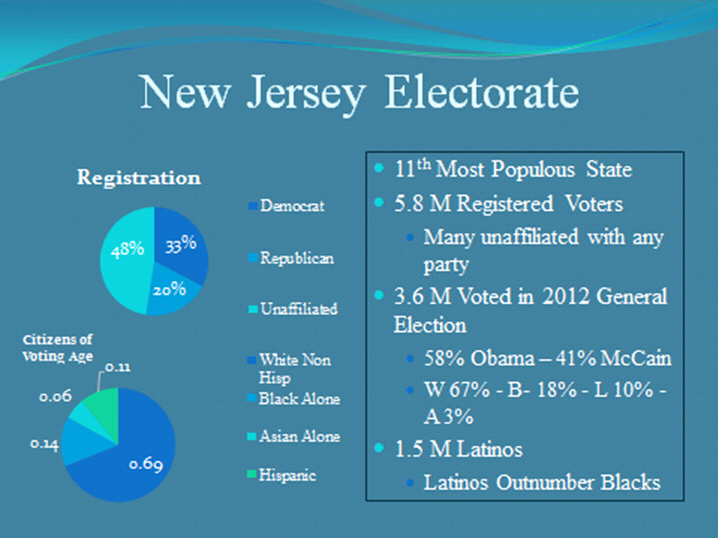
As PAC+ begins the final stretch of this primary election, we must continue encouraging New Jersey’s multiracial new majority to engage in the electoral process. We must stay committed to advancing our mission of expanding the electorate to include voters who remain on the political margins of our society.NJ Demo

This expansion will be accomplished by enhancing and broadening key components of our efforts — combining traditional civic engagement programs with 21st century demographic data and civic engagement technology.

The technology, strategy and staff put in place gives us the capacity to carry out a plan to train, educate, and mobilize a significant number of voters of color (VOC) in the primary. As a result, PAC+ is now in a position to help elect Cory Booker.

For PAC+ this epic moment presents both a historic opportunity as well as a significant responsibility. Created to build a voter program that is driven by New Jersey’s changing demographics, we felt compelled to make this chance for New Jersey to elect its first African American U.S. Senator our marque effort for 2013.

I remember when we first started this journey in 2011. I remember how challenging it was to excite New Jersey civic engagement organizations about demographic politics — something that is going to happen in the future but already impacting the political landscape. We started with a poll, evidence based data, and a voter file. After two years of hard work, election votes will be calculated and results evaluated.

It was like a roller coaster ride. By mid-June it appeared that there would be a turnout problem in eight New Jersey counties with historically low VOC turnout rates. According to internal data the counties of Atlantic, Bergen, Burlington, Camden, Gloucester, Middlesex, Passaic, and Salem were in danger of suffering low midsummer turnout rates.

For example, in Atlantic only 7,572 votes were cast in this year’s Democrat gubernatorial primary. Then Bergen, peculiar for north New Jersey, reported just 14,036 votes – far lower than the 16,197 from 2005. In Gloucester only 5,613 residents voted – almost 1,000 less than in 2005. In Middlesex we saw a 4,991 vote drop from 2005. All of those counties had turnout rates considerably better in 2005.

The numbers in Atlantic County were especially troubling because both the Democrat and Republican campaigns had spent a considerable amount of time engaging Jersey shore voters who were impacted by Hurricane Sandy. Clearly the multiple issues related to recovering from a disaster were a factor in the decreased effectiveness of conventional voter contact programs.
What very few realized is that Atlantic also underwent a political geographical transformation as well. In 2010, the county’s population increased by 8% with 16,000 inactive voters and 56,000 unregistered residents. Moreover voters of color make up 39% of the population.

In a few days, we will see the true value of an organized VOC electorate during a low turnout election. Recognizing the power that VOC have in pushing their candidate to the top, PAC+ was determined to follow the advice of Yale professor Don Green: “personal contact by a trusted messenger is the gold standard.”

Unlike most political organizations, PAC+ did not neglect this core principle in its efforts to reach VOC. It’s reflected in everything from our data collection strategies to cross-platform civic engagement and was utilized to strategically micro-target voters of color.

The power of this moment is the narrative which describes what most political experts know is true –if we strategically register, educate, and turnout VOC we can not only flip the outcomes of their specific neighborhoods and districts, but have major impact in deciding the next Mayor, U.S. Congressman, U.S. Senator and Governor.

###

Kirk Clay is Senior Advisor at PowerPAC

YOUNG VOTERS OF COLOR HAVE THE ABILITY TO BREAK THIS CYCLE OF DYSFUNCTION

By Kirk Clay

Can Anger and Frustration Be Channeled to Achieve Significant Gains in Politics?

Two years after President Abraham Lincoln issued the Emancipation Proclamation, enslaved People of Color

Summary Map of counties covered and not covere...
Summary Map of counties covered and not covered by the Emancipation Proclamation. (Photo credit: Wikipedia)

(POC) in Texas received word from the Union Army on June 19, 1865, that they were free. Today, that date is remembered and celebrated as Juneteenth and it commemorates the celebration of freedom for all Americans. It is also the day Election Protection – a program designed to protect all American’s right to vote – was launched. The pilot program was launched in Virginia’s 2001 special election to fill a seat in Congressional District 4.

I remember the day we began Election Protection – it was in response to the November 2000 election disaster. Progressive Whites and Voters of Color (VOC) in many states registered and turned out in record numbers, but many were turned away or had their votes invalidated.  We all know the story line of that election. But, in the discussion about which candidate won or lost and why, what is often unnoticed is that the biggest losers were, without a doubt, the voters.

Just like the disenfranchisement of 2000, floods of regressive laws that are being passed in red state legislatures today are hurting voters. The Tea Party extremists behind these initiatives remind us of how fragile our voting rights really are. In fact, VOC still face a combination of systemic inequities, inadequate voter education, and inappropriate actions by government officials. To make matters worse, as expressed at a recent anti-immigration rally, many of these obstructionists believe “The Melting Pot Floweth Over.”

There is a real danger that the actions of these politicians could fuel cynicism and apathy in our democracy. What if potential young voters and voters of color (VOC) respond by reaffirming the sentiment that their vote is unlikely to change this dynamic? This is especially a problem among first time voters that made strides last year in electing officials that share their interests. Note that these voters are historically marginalize in mid-term elections anyway and are more likely to get stuck in a long line or have their votes discarded altogether.  But along with that vulnerability, there is the real problem of intentional voter suppression.

For example, while voters under 30 were 21% of the electorate in Virginia in 2008 that number dropped to 10% in 2009. Also, voters waited an average of 23.6 minutes to vote in 2012 and their number didn’t match 2008.

This could be pivotal in a district of influence – Congressional district that is not necessarily majority minority but has enough diversity to impact the election. Like Virginia’s CD-4 which is close to 5% Latino, 31% African American, 2% Asian and President Obama garnered close to 50% of the vote.

That’s why it’s so important to invest in these communities early. These near-tragedies of generational subjugation can be avoided with a cross platform civic engagement program. You can shape the future of politics by taking compassionate measures and advancing the authentic voices of our movement. That process begins with embracing diversity. The greatest gift we can give to our future leaders is an opportunity to vote.

In the end, getting young people to engage in politics is like trying to push a boulder over a hill. When you have a strong progressive coalition to help, that boulder begins to move more quickly. For better or worse, young voters of color will move to the next phase during which the boulder will begin to charge down the hill. The impact of this rolling stone could be epic. Politically, you do not want to be on the other side of the boulder.

###

Kirk Clay is Senior Advisor at PowerPAC